
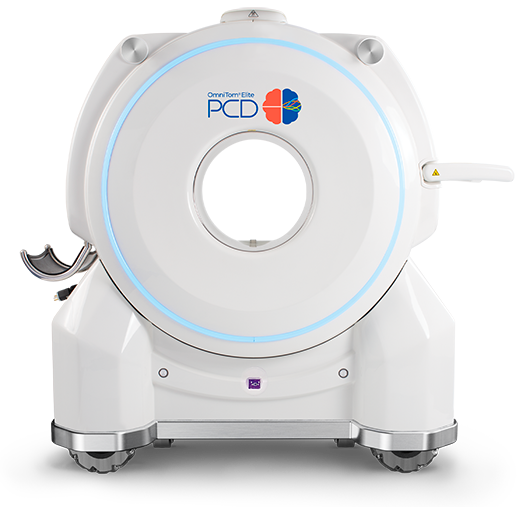
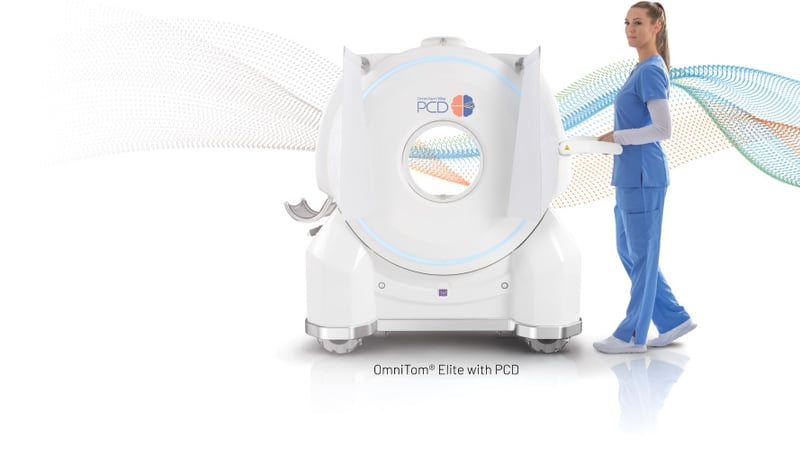
OmniTom® Elite with PCD

The OmniTom Elite with PCD combines advanced photon-counting detector technology with true mobility, delivering ultra-high-resolution, spectral imaging that enhances tissue characterization, improves diagnostic confidence, and can potentially reduce radiation dose and contrast usage. By bringing CT directly to the bedside, it also minimizes patient transport risks and enables faster, more efficient point-of-care decision-making in critical environments like the ICU, ER, and OR.


NeuroLogica Logo_Primary 2025

usa-samsung-mct-omnitom-pcd-header-1


Get the Highlights


PCD Insight. Wherever Care Happens. 

When a confident diagnosis is timely and critical, the OmniTom® Elite Photon Counting mobile CT scanner advances your standard of care in a single scan.  The NeuroLogica mobile CT scanner was designed to bring imaging closer to the bedside in order to reduce risks associated with transporting critically ill patients to the CT suite. The scanner can be moved around the hospital from one room to another, or an ER or operating room for intra-operative imaging.

EID versions of this scanner are commonly used in ICUs to monitor the daily status of critical patients. Several mobile stroke units equipped with NeuroLogica's CereTom or OmniTom head CT scanners are also currently in use to improve the treatment of stroke patients worldwide.  The OmniTom also accommodates neonate and pediatric scanning.

The mobile PCD-CT was built by combining two key technologies for the first time: portability and photon counting.

 
omnitom-elite-pcd-human-shot

Reduce Transport Related Incidents and Infections1

omnitom-stats-01


 Photon-counting detectors (PCDs) directly convert incoming x-ray photons into electrical signals, eliminating the intermediate light conversion step used in traditional energy-integrating detectors (EIDs), which reduces electronic noise and improves dose efficiency—especially at lower radiation levels. They also measure the energy of each individual photon, enabling true spectral imaging that enhances tissue differentiation, improves contrast-to-noise ratio, and supports more precise material characterization. In addition, PCDs offer inherently higher spatial resolution due to smaller detector elements, allowing for sharper visualization of fine anatomical structures and potentially earlier, more confident diagnoses.


OmniTom Workflow

Moving the OmniTom with one person to the point of care for the patient allows for imaging where you need it.

Adapt the patient bed for scanning without the struggle

CT Imaging at the point-of-care when it's needed most

Image Quality for Better Results

Photon Counting Detector (PCD) Technology
omnitom-elite-pcd-vmi-images
Virtual mono-energetic images (VMI) – results of VMI with OmniTom Elite with PCD
omnitom-elite-pcd-icu-hemorrhage
Neuro ICU Patient (Intracerebral Hemorrhage)
omnitom-elite-pcd-material-composition
Material decomposition – differentiating hemorrhagic and non-hemorrhagic (iodine staining) lesions. The blood brain barrier breakdown without hemorrhage by thrombectomy.
omnitom-elite-pcd-vnc
VNC (Virtual non-contrast)
omnitom-elite-pcd-hemorrhage
Hemorrhage Diagnosis – Parenchymal hemorrhage along the right frontal catheter tract. Also, Subarachnoid hemorrhage.
omnitom-elite-pcd-intracerebral-hemorrhage
Intracerebral Hemorrhage Diagnosis – Intracranial multi-compartmental hemorrhage, stable compared to the most recent study
omnitom-elite-pcd-iodine
Iodine Staining –  Differentiating hemorrhagic and non-hemorrhagic (iodine staining) lesions
The blood brain barrier breakdown without hemorrhage by thrombectomy.
  • OmniTom Elite with PCD may not be commercially available in some countries.

  • Sales and shipments are effective only after approval by the regulatory affairs.

  • Please contact your local sales representative for further details.

  • This product is a medical device; please read the user manual carefully before use.

  • All images are copyrighted to their respective owners.

(1) Halperin, John J., Stephen Moran, Doriann Prasek, Ann Richards, Charlene Ruggiero, and Christina Maund. “Reducing Hospital-Acquired Infections Among the Neurologically Critically Ill.” Neurocritical Care, 2016, 1–8. doi:10.1007/s12028-016-0286-2

Request More Info or Schedule a Demo